
SLAP tears
SLAP lesion, ever wondered what it really means?
SLAP is an abbreviation for Superior Labrum Anterior Posterior. Still confused? Let’s dive into it a bit deeper.
Anatomy:
SLAP lesion is an injury of the labrum of the shoulder, the Glenohumeral joint (GHJ). The GHJ is formed between the humerus and the scapula. The part of the scapula that articulates with the humerus is called the glenoid. The labrum is a type of cartilage that is situated in the glenoid fossa. Compared to the inferior part of the glenoid labrum, the superior part is more mobile. The tendon of the long head of the biceps attaches onto the anterosuperior part of the labrum.
The function of the glenoid labrum is to add more stability to the GHJ.
Types of tears:
SLAP tears are divided into 4 main types of tears. However there are as many as 10 classifications.
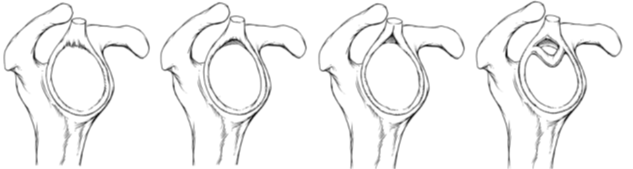
Fig. 1
a) Type-I SLAP tear: superior labral fraying with localized degeneration.
b) Type-II SLAP tear: detachment of the superior labrum/biceps anchor from the glenoid.
c) Type-III SLAP tear: bucket-handle type tear of the superior labrum with an intact biceps anchor.
d) Type-IV SLAP tear: bucket-handle tear of the superior labrum with extension of the labral tear into the biceps tendon. © JHU 2018/AAM
Aetiology:
SLAP tears can be one of the major causes of shoulder dysfunction. SLAP injuries can either be due to overuse, repetitive stress to the structures over time, or a sudden acute injury of the structures.
These tears often occur during repetitive overhead and throwing sports/activities but can also happen during a traction injury to the arm, compression loads directly through the shoulder (falling with your arm stretched out) or when a direct traction force of the biceps tendon occur.
Signs and symptoms:
One may experience varies of symptoms like shoulder pain, especially with overhead activities, an instability feeling, popping or catching feeling that is painful, feeling of weakness or ‘dead arm’ syndrome. In others there is not always disability feeling and symptoms may flare-up and subside.
Together with the SLAP tears, related shoulder injuries may occur, including internal impingement, tears of the rotator cuff and glenohumeral instability. These may present with weakness, instability and night pain.
Diagnosis and Physical examination:
To get a diagnosis please consult a Physiotherapist or Medical Practitioner.
Examination will include a subjective and objective(physical).
Subjective assessment will include taking a full, comprehensive history of current and past presentations and injury. Included with this will be a full medical history as well.
The objective assessment will include active and passive movements, special tests (this is tests to stress the different structures to make a more accurate diagnosis) and neurological (nerve) testing. Palpating the different muscles, bones, joints and ligaments will part of the assessment.
Treatment:
Treatment is depended on an accurate diagnosis due to the complexity and related shoulder injuries.
Traditionally, management will begin with a conservative, non-operative approach for 3-6 months. This management includes rehabilitation, medication and/or injections (prescribed and administrated by a Medical Doctor).
Surgical intervention may be considered if conservative management has failed to return to pre-injury level/desired level of activity or regained the full range of motion.
Surgical intervention will be depending on the type of lesion and the Orthopaedic surgeon performing the surgery.
Return to sport and work:
The anterosuperior, anterior and superior parts of the labrum have decreased blood supply. This makes the labrum more susceptible to injury and the healing process slower.
Return to work and sports activity may vary in time due to the severity of the injury and the intervention required.
This can be anything from 3 months for certain work and sports activities to more than 6 months. In some cases, it can take longer.
Please consult a Physiotherapist near you or a Health Care Practitioner for an accurate diagnosis, sooner rather than later if you are experiencing any shoulder pain related to an acute or overuse injury or a sudden onset without any mechanism of injury.
Leave a Reply